Slum Village, Album by Album: A Listening Guide to Detroit's Jazz-Rap Crew and the Pieces to Match

Picture three friends from Conant Gardens, a neighbourhood on Detroit's northeast side, who all went through Pershing High School. Baatin, T3 and Jay Dee, the producer the world would come to know as J Dilla, started Slum Village in the mid-1990s. What they built is a hip-hop and jazz rap catalogue that sounds soulful, loose, warm and very Detroit.
If you have only heard a track or two, the catalogue can look like a lot. It spans close to three decades, several lineups and ten albums. This guide walks you through it in order, says where a new listener might start, and ends with the Slum Village pieces that suit each kind of listener.
Where does the Slum Village story begin?
It begins with a record most people heard years after it was made. Fan-Tas-Tic (Vol. 1) was recorded in 1996 and 1997, long before it reached a wide audience in 2005 and 2006. It is the raw early sound of the group: the three founders, Jay Dee's beats and a lot of room to breathe.
Then came Fantastic, Vol. 2, released on Good Vibe in June 2000 after a troubled first label deal. It is a natural first stop for a new listener. J Dilla left after it, in 2001, to go solo.
If you want the full early run in one sitting, the group's own write-up from Fantastic to Trinity takes you through those first records and the change that followed.
What changed after J Dilla left?
A new chapter, not an ending. Trinity (Past, Present and Future) arrived in 2002, the first album after J Dilla's departure, and T3 brought in Elzhi as a new voice. Trinity carried the single "Tainted", featuring Dwele, which reached number 87 on the Billboard Hot 100.
Two years later came Detroit Deli (A Taste of Detroit) in 2004 and, with it, "Selfish", featuring Kanye West and John Legend. That single climbed to number 55 on the Hot 100. A self-titled album, Slum Village, followed in 2005.
The lineup kept moving through these years:
- Baatin left around 2003 and rejoined in 2008.
- Illa J, J Dilla's younger brother, and Young RJ joined in 2008.
- Elzhi left in July 2010.
The group also lost two of its founders: J Dilla died on 10 February 2006 and Baatin on 31 July 2009. Any look back at Slum Village is also a way of remembering them both.
Which later albums should you know?
The 2010s are an underrated stretch. Villa Manifesto (2010) was followed by Evolution (2013), Yes! (2015) and Vol. 0 (2016). Then, in 2024, came F.U.N, the most recent album on the list. Today Slum Village is T3 and Young RJ.
The group's post from Detroit Deli to F.U.N covers this later run album by album, and it is a good companion if you are listening your way forward from the 2000s.
A simple way in, if you are new:
- Start with Fantastic, Vol. 2 for the classic sound.
- Move to Trinity and Detroit Deli for "Tainted" and "Selfish".
- Finish with F.U.N to hear where the group is now.
Singles worth adding to that playlist include "Climax", "Raise It Up", "Disco", "Do You" and "EZ Up".
Which Slum Village piece suits which listener?
The group's designs are as easy-going as the records. Here is how they line up with the kinds of people who love this music.
The one who loves the warm, sunny side of the sound. The Doghouse Sign design is a full-colour cartoon: a bearded man in a yellow cap and a zigzag shirt holding a red flag, a girl in a blue dress looking up at him, and a red doghouse with a white SLUM VILLAGE sign and a little yellow bird perched on top. It is playful and bright, and it works well on the Doghouse Sign crewneck sweatshirt for cool evenings.
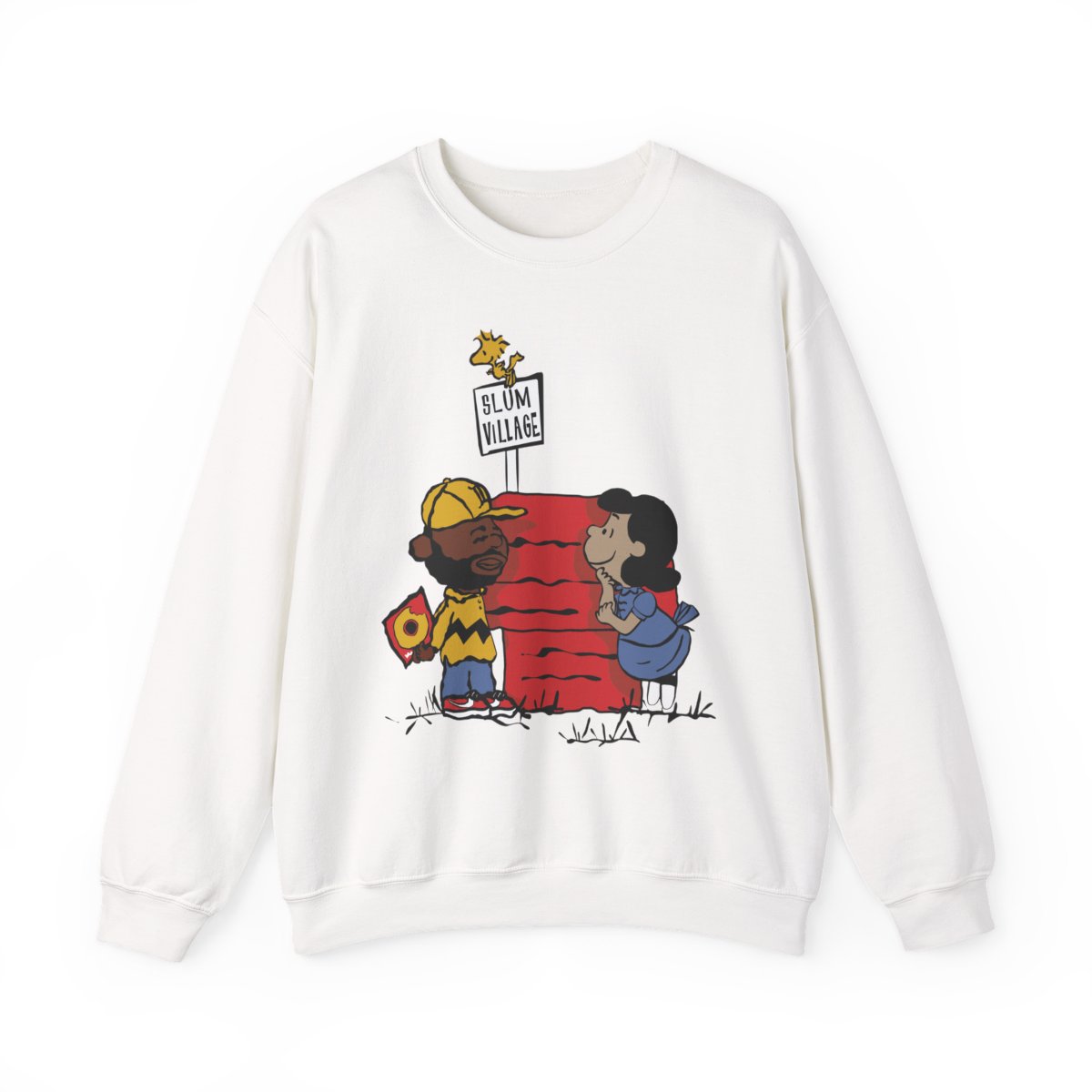
The younger listener in the house. The same cartoon is even more fun on kids' and youth sizes. The Doghouse Sign youth hoodie is a cosy pick for a kid who already knows the hooks from the car stereo.
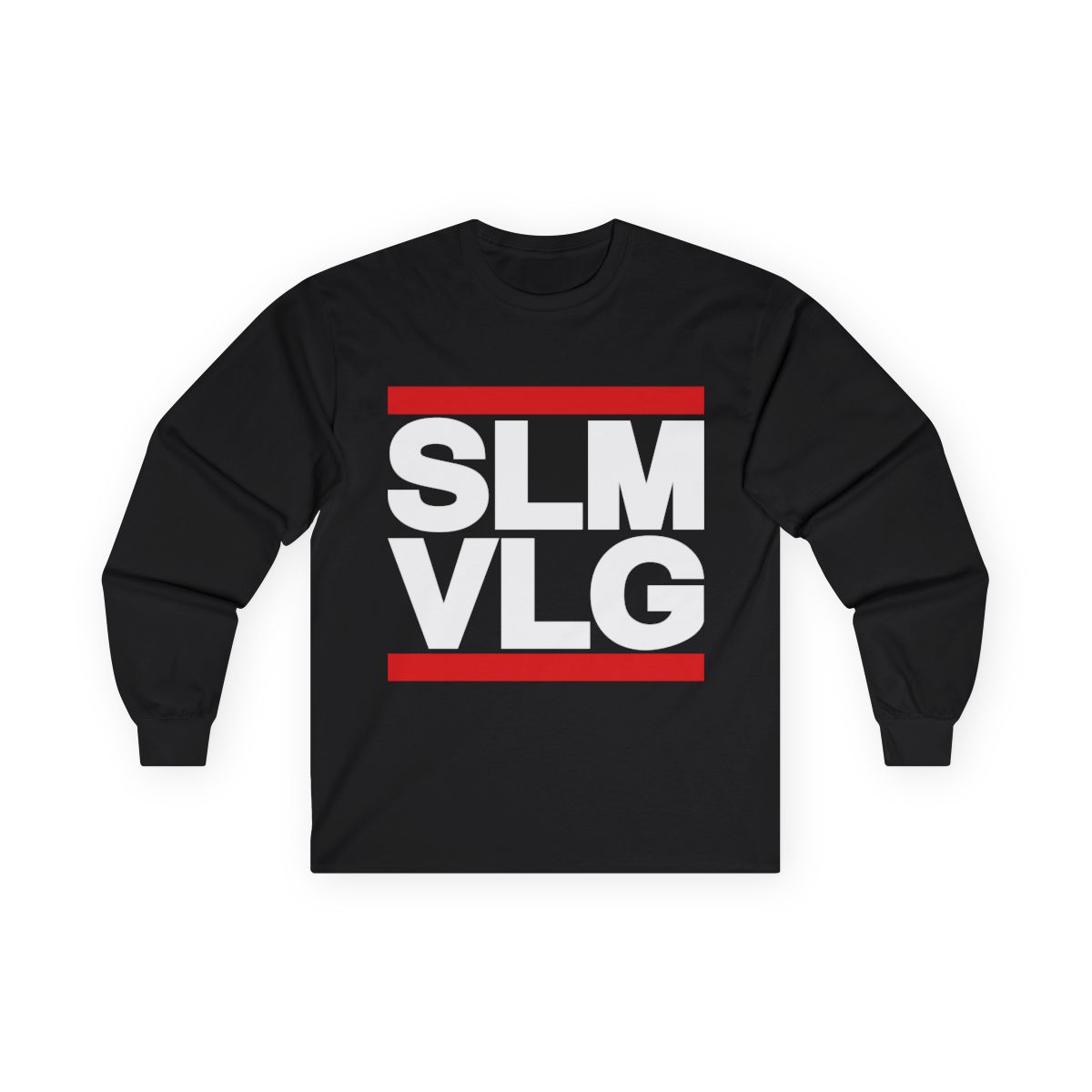
The minimalist. The Red Bars design keeps things clean: two solid red bars framing the top and bottom edges of a bold, minimal Slum Village graphic. On the Red Bars long sleeve tee it layers easily under a jacket, the kind of piece you reach for without thinking.
The quiet one. Light Mark 603 is the understated choice, a light Slum Village graphic that sits softly on the garment. It comes on youth crewnecks and hoodies for anyone who prefers a whisper to a shout.
The holiday host. For the season, the Christmas Knit hoodie sets bold red SLUM VILLAGE lettering between green pixel trees and zigzag borders, with a row of red pixel gift boxes along the bottom of the back. It is a cheerful answer to the ugly-sweater party.
Why does this catalogue still matter?
Because it rewards you every time you come back to it. The early records show three friends from one Detroit neighbourhood shaping a sound around jazz and soul. The middle years show a group keeping going through loss and change, landing on the charts with Dwele, Kanye West and John Legend. The later albums, all the way to F.U.N, show T3 carrying it on with Young RJ.
So start where the story starts: put on Fantastic, Vol. 2 and let the music do the rest.